
What is a call number?
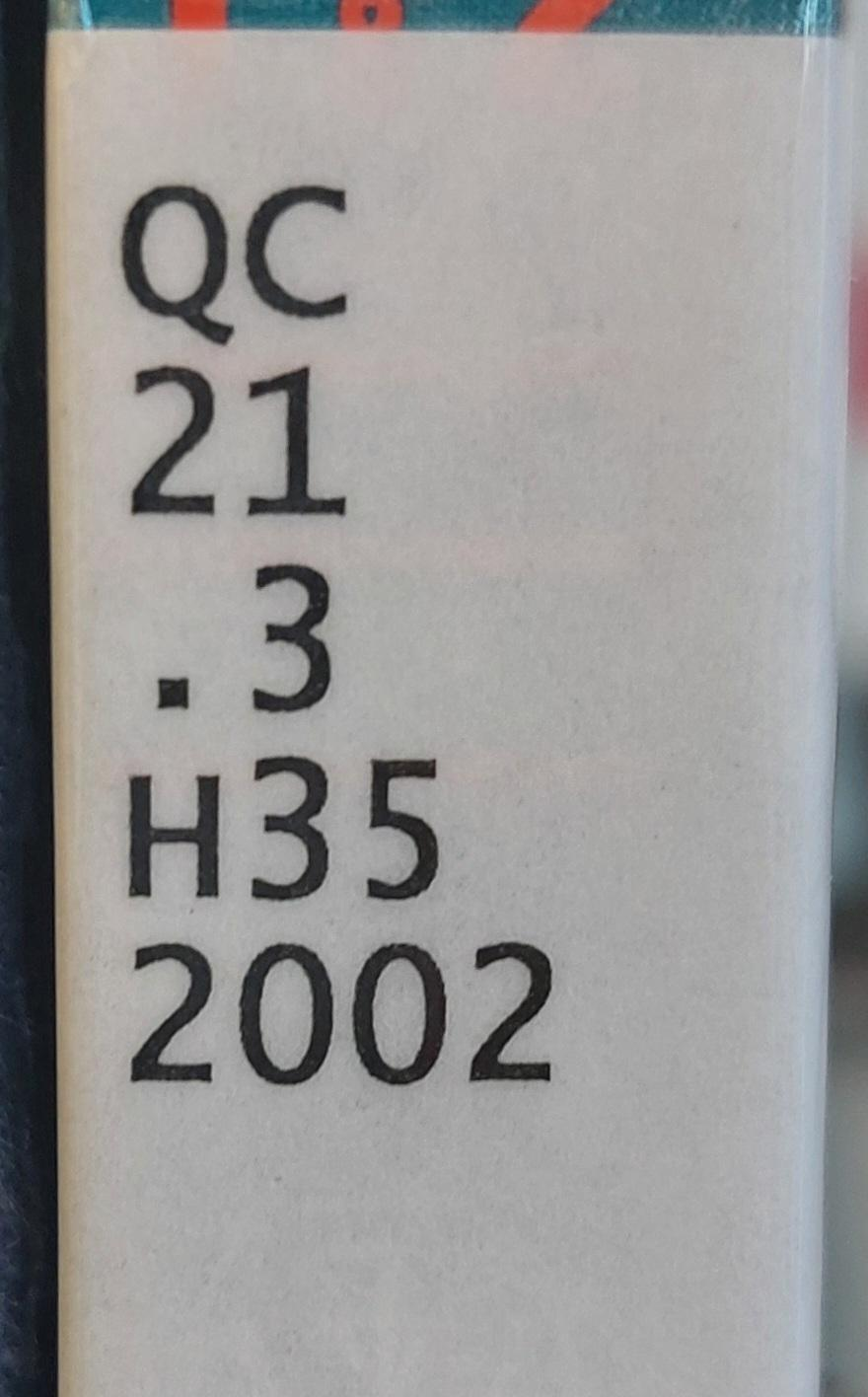
Call numbers are like the address of a book. They provide a path to locating a book or other resource in our library collection. At York Libraries, we use the Library of Congress classification system to make call numbers. You’ll find call numbers both on a book’s spine and on the library website.
| Book’s spine | Book’s record on the library website (OMNI) |
|---|---|
 |  |
How do I read call numbers?
You read each piece or line of the call number individually. Using the example above (QC 21.3 H35 2002):
| QC | Read this line in alphabetical order: A, B, BF, BK, BP, C ... all the way to Z. |
| 21 | Read this line as a whole number: 1, 2, 3, 100, 101, 1000, 5001, 5980 ... all the way to 9999. |
| .3 | Read this line as a decimal: .1, .10, .100, .1260, .2, .23, .4, .4590, .6, .600, .9 This might feel counter-intuitive, since you’ll have large decimals (.1567) followed by small decimal (.2), but take it one number at a time! Not all call numbers have a decimal, so in that case, skip this step. |
| H35 | This line is a combination of a letter and number. Read the letter in alphabetical order. Read the number as a decimal. Some examples in correct order: A20, A200, A23, B30, B450, B55 Some call numbers might have two of these letter/number combinations. Follow the same steps to read it. |
| 2002 | This is the publication year, which is important if we have multiple editions of the same book. Read this line in chronological order: 1988, 1995, 2003, 2010, 2025 |
Call number 101
Want more practice?
Put your knowledge to the test! Try our quiz to put these York Library books in the correct call number order: